The Anchor Table: How Becoming a Regular at Your Bistro Quietly Heals You

Photo by Photo by Yunshuo Qu on Unsplash on Unsplash
There is something quietly profound about the moment a bistro staff member greets you by name before you have spoken a word. For millions of Americans, the act of returning to the same table, week after week, has become far more than a dining habit — it has become a form of emotional sustenance that neuroscience is only beginning to fully appreciate.
In an era defined by remote work, fractured social calendars, and the peculiar loneliness that can accompany a hyper-connected digital life, the neighborhood bistro has emerged as an unlikely sanctuary. Not because it offers escape from the world, but because it offers something rarer: a reliable place within it.
The Neuroscience of the Known
When psychologists speak of "predictive reward," they are describing the brain's deeply ingrained preference for environments where outcomes can be anticipated. Dr. Wendy Suzuki, a neuroscientist at New York University whose work on memory and emotion has gained wide attention, has noted that repeated positive experiences in a specific context do not merely feel pleasant — they actively reinforce neural pathways associated with calm and security.
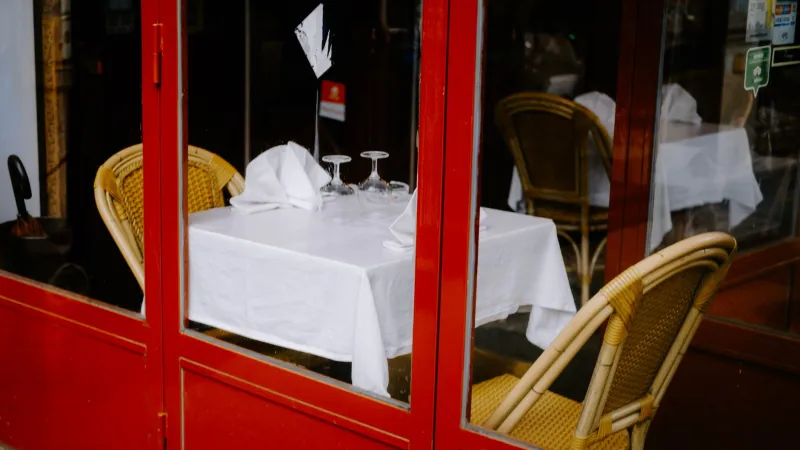
Applied to dining, the implications are striking. The familiar weight of a particular chair, the way afternoon light falls across a corner table on a Thursday evening, the server who already knows you prefer still water and a moment before ordering — none of these details are trivial. Together, they compose a sensory vocabulary that the brain recognizes as safe. And safety, at a neurological level, is the precondition for genuine relaxation.
This is precisely why so many people describe their regular bistro table not as a place they go, but as a place they return to — a distinction that carries enormous psychological weight.
Ritual as Architecture
Marjorie Ellison, a retired schoolteacher from Evanston, Illinois, has occupied the same two-top near the window of her neighborhood bistro every Sunday morning for eleven years. Her order has not changed appreciably in that time: a soft-boiled egg, sourdough toast, and a pot of Earl Grey. She arrives at half past nine and departs before noon.
"People ask me why I don't try somewhere new," she says, without particular defensiveness. "But the point isn't novelty. The point is that I know exactly what Sunday morning feels like. That matters more than I can explain."
What Marjorie describes, intuitively, is the structural function of ritual. Anthropologists have long understood that rituals — whether religious, civic, or deeply personal — serve as organizing frameworks for time and identity. They answer the question who am I? by first answering where do I belong?
For many Americans, particularly those navigating major life transitions such as divorce, relocation, retirement, or the quiet aftermath of the pandemic years, the answer to that second question has become genuinely uncertain. The neighborhood bistro, for those who allow themselves to become regulars, offers one of the few remaining answers that does not require a screen, a subscription, or a social media profile.
The Staff as Witnesses
There is a particular kind of relationship that forms between long-time patrons and the professionals who serve them — one that defies easy categorization. It is not friendship in the conventional sense, yet it carries a warmth and continuity that many friendships fail to sustain.
Daniel Reyes, a front-of-house manager at a well-regarded bistro in Portland, Oregon, describes it with careful precision. "You become a witness to someone's life without either party ever naming it that way. A guest comes in every Friday for two years, and you notice when they seem lighter, when something has gone wrong, when they're celebrating something they haven't told anyone else yet. That's an intimate thing, even if it never becomes personal."
This dynamic — attentive but not intrusive, consistent but not presumptuous — is arguably one of the most emotionally sophisticated services a well-run bistro provides. Psychologists sometimes refer to this as "ambient belonging": the sense of being known and acknowledged within a social space without the obligations that accompany closer relationships. For many people, particularly those living alone or far from family, ambient belonging is not a luxury. It is a lifeline.
When the Table Holds the Week Together
Consider the function that a regular bistro visit performs in practical terms. It creates a fixed point in an otherwise fluid schedule. It provides a social interaction that is warm but low-stakes. It offers sensory pleasure — good food, considered service, a thoughtfully composed room — that is both immediate and repeatable. And it situates the individual within a community of other regulars, a loose constellation of familiar faces whose presence, even unacknowledged, communicates that one belongs to a shared place.
Research published in the journal Personality and Social Psychology Bulletin has suggested that even weak social ties — the kind formed with neighbors, local shopkeepers, and yes, bistro staff — contribute meaningfully to overall life satisfaction and reported happiness. The depth of a relationship, it turns out, is not always the measure of its value.
Thomas Nguyen, a software engineer in Austin who began dining alone at his neighborhood bistro every Wednesday evening after a difficult relocation from Boston, speaks to this with some candor. "I didn't know anyone in the city for the first year. But I knew the people at that restaurant. I knew the pasta changed with the season. I knew the bartender's name. That was enough to make Austin feel real to me."
The Table as a Form of Self-Knowledge
There is one more dimension worth considering, and it is perhaps the most intimate of all. A regular table is not only a place where one is known by others — it is a place where one comes to know oneself.
In the consistency of a repeated experience, small changes become visible. The diner who once ordered the richest dish on the menu and now finds himself drawn to something lighter. The woman who used to arrive with a companion and now comes alone, and has made a kind of peace with that. The couple who began as strangers at adjacent tables and now, years later, nod at each other with the warmth of those who have shared something unnamed.
A bistro, at its finest, is not merely a place of consumption. It is a place of accumulation — of moments, of small recognitions, of the quiet evidence that one's life is, in fact, proceeding. That it has texture and continuity and witnesses.
At Ellison Bistro, we have always believed that every table holds a story. What we have come to understand, over years of watching guests return to the same corners and chairs and views, is that for many of those guests, the table does not simply hold the story.
It is where the story becomes clear.