Ink on Linen: The Secret Lives of Bistro Napkins and the Thoughts They Keep
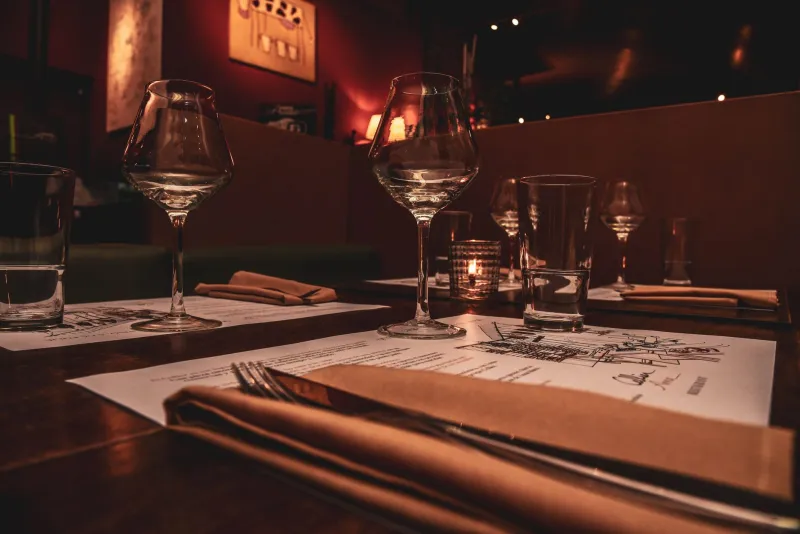
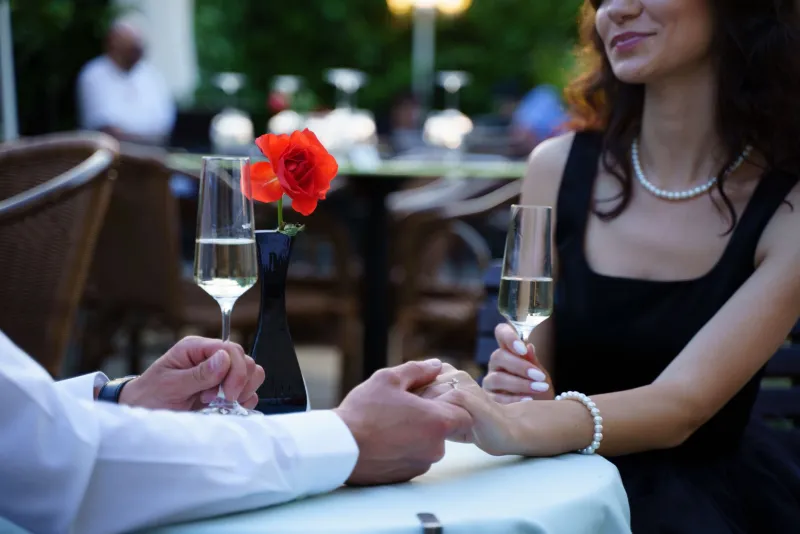
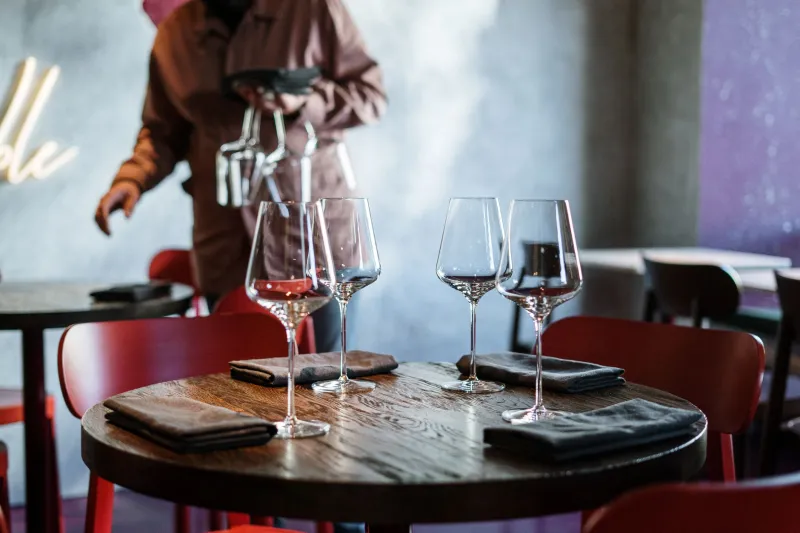
There is a particular quality to the light at Ellison Bistro in the hour after the dinner rush begins to soften—when the room settles into a kind of shared exhalation and conversation drops from performance to something more private. It is precisely in these moments, our staff has come to understand, that the napkins appear.
Not the napkins as table dressing, precisely folded into their place settings with the careful geometry of a room prepared to receive guests. Rather, the napkins as instruments. Unfolded, smoothed against the tablecloth, and pressed into service for something no menu could ever anticipate.
What the Servers See
Among the observations that members of our front-of-house team share most frequently, the act of a guest reaching for a pen—or, more often, asking to borrow one—ranks among the most quietly remarkable. It is a gesture that carries its own particular weight. A guest who asks for a pen mid-meal is not composing a grocery list. They are in the grip of something.
Our servers have developed, over years of attentive service, an intuition for the moment. A couple leaning close over a shared dessert, one of them pressing a folded napkin across the table with a kind of careful deliberateness. A solo diner at a window table who pauses mid-entrée, stares past the room for a long moment, then writes something in three swift lines before folding the napkin into a pocket. A group of colleagues who have long since abandoned the pretense of a business dinner, one of them sketching what appears to be an organizational chart—or perhaps an architectural floor plan—on the white linen while the others lean in with the conspiratorial energy of people who have just decided something important.
These are the scenes that accumulate quietly in the memory of a place that has been paying attention.
The Taxonomy of a Bistro Napkin
If one were to catalog the categories of thought that Ellison Bistro's tables have absorbed over the years, the list would be both mundane and extraordinary in equal measure.
Phone numbers remain the most common inscription—scrawled in the particular handwriting of someone who is simultaneously confident and terrified. There is a meaningful distinction, our team has noted, between a number written slowly and deliberately and one written quickly, as though speed might outrun second-guessing. Both varieties have been left behind on napkins that guests, in the distraction of a charged departure, carried away in a coat pocket or left folded beneath a water glass.
Business ideas occupy a different register entirely. These tend to arrive in fragments: a product name circled twice, a rough diagram of something that might be a logo or a workflow, a single word underlined with the urgency of someone who does not trust themselves to remember it by morning. The bistro table, it seems, is a reliable incubator for the kind of lateral thinking that the formal office resists.
Apologies are perhaps the most affecting category, and the one our staff speaks of with the most care. These are rarely addressed to anyone present. They are written in the private language of someone working through something unresolved—a few sentences that trail off, a name written and then covered over, a draft of something that will likely never be sent. The bistro, in these instances, functions less as a restaurant and more as a secular confessional, offering the particular privacy that only a public space can provide.
Poems, too, appear with a frequency that might surprise those who do not dine here often. They arrive in couplets or fragments, occasionally rhymed, more often not. They are love poems and grief poems and poems that appear to be neither—simply an arrangement of words that someone needed to make visible before the feeling passed.
The Architecture of Unguarded Thought
What is it about the bistro table, specifically, that licenses this kind of expression?
The answer likely lives in the intersection of several conditions that Ellison Bistro works deliberately to cultivate. The ambient warmth of a room designed to slow the pace of human interaction. The particular suspension of ordinary time that accompanies a well-constructed meal—where the next course has not yet arrived and the last one has just been cleared, leaving a brief interval in which the mind is neither anticipating nor digesting, but simply present. The slight loosening that accompanies a good glass of wine chosen with care.
Together, these conditions produce something that the psychologist Mihaly Csikszentmihalyi might recognize as a threshold state—not quite flow, but adjacent to it. A moment in which the internal editor relaxes its grip and something more authentic moves forward.
The napkin, in this context, is simply the nearest available surface.
What We Choose Not to Read
It would be easy, and perhaps tempting, to frame Ellison Bistro as an accidental archive—a place quietly accumulating the unguarded interior lives of its guests. There is truth in that framing, but it requires a companion observation.
Our staff does not read what is written on the napkins that are left behind. This is not a formal policy so much as a shared understanding, one that speaks to the fundamental contract of hospitality: that what happens at a table belongs to the people who were seated there. The napkin that remains after guests depart is folded and cleared with the same practiced neutrality as the glassware. Whatever it held is treated as private, because it was.
What our team does carry forward is the impression—the texture of the moment, not its content. The sense that something significant passed through the room, that the table served a purpose beyond the meal, that the evening mattered in a way that extended past the final course.
The Lasting Weight of Small Paper
Ellison Bistro has never marketed itself as a place where important things happen. That framing would be both presumptuous and inaccurate. We offer a composed room, a considered menu, and the kind of attentive service that knows when to be present and when to withdraw.
What guests bring to those conditions is entirely their own.
And yet, there is something that accumulates in a place where people have consistently chosen to think aloud on paper—where the napkin has been pressed into service as a medium for the thoughts that could not wait, the feelings that needed form, the ideas that arrived unbidden between the salad course and the main. A bistro that has witnessed enough of these moments carries a kind of invisible sediment: the residue of all the human work that has been done quietly at its tables.
Where every table has a story, some of those stories begin—and occasionally end—on a square of folded linen, pressed flat by a hand that needed to make something permanent before the evening moved on.
We are honored to have provided the surface.