The Sacred Pause: Why the Space Between Ordering and Eating Defines the Whole Meal
Long before the first plate reaches the table, something essential is already happening. The interval between an order placed and a dish delivered is not empty time—it is, in the hands of a thoughtful bistro, the most carefully engineered moment of the evening. Understanding what unfolds in that pause reveals why certain meals stay with us for years.
There is a particular quality to the silence that settles after the server lifts the menus and walks away. Glasses are lifted. Shoulders drop an inch. The conversation, which may have been navigating the careful formalities of a first meeting or the comfortable rhythms of a long partnership, shifts into something less guarded. The decision has been made. The kitchen has been trusted. And now, for a stretch of minutes that belongs entirely to the guests, the evening opens.
The Architecture of Waiting
In culinary circles, the focus on anticipation is rarely spoken about as plainly as it deserves. Chefs discuss technique, sourcing, plating, and flavor balance with great precision. Front-of-house teams are trained in timing, attentiveness, and the art of reading a room. But the deliberate cultivation of the pre-arrival interval—the conscious shaping of what guests experience before the food appears—represents one of the more sophisticated and underappreciated disciplines in refined dining.
At its core, this discipline rests on a simple psychological truth: desire intensifies with delay. Neuroscience has long documented that the anticipation of a reward activates the brain's dopamine system at least as powerfully as the reward itself. In a bistro context, this means that a well-paced wait—one that feels unhurried rather than neglected—can heighten a guest's sensory readiness in ways that make the eventual dish taste more vivid, more memorable, more complete.
This is not accidental. The most attentive dining rooms in America understand that the kitchen's work does not begin when the stove ignites. It begins the moment a guest sits down and starts to imagine what the evening might hold.
What Happens in the Interval
Consider what actually takes place in those minutes between ordering and eating. Conversations deepen. The removal of the menu—that last administrative object between two people—often signals permission to speak more freely. Couples who have been distracted by the day's obligations find themselves genuinely looking at one another. Friends who have been meaning to have a difficult or important conversation discover that the structure of the meal gives them both a reason to stay at the table and a natural rhythm to follow.
Business dinners, too, transform in this interval. The negotiation that has been circling its subject for weeks sometimes finds its footing between the bread course and the entrée. The apology that needed a neutral setting finally arrives. The celebration that deserved a proper toast gets one.
A bistro that understands this will not rush it. The bread, when it comes, is not merely sustenance—it is a gentle signal that the kitchen is aware of you, that the evening is moving forward, that you are held. A well-timed amuse-bouche, placed without ceremony but with evident care, can extend the anticipatory state rather than collapse it, offering a small sensory note that suggests what is coming without fully delivering it.
The Server as Conductor
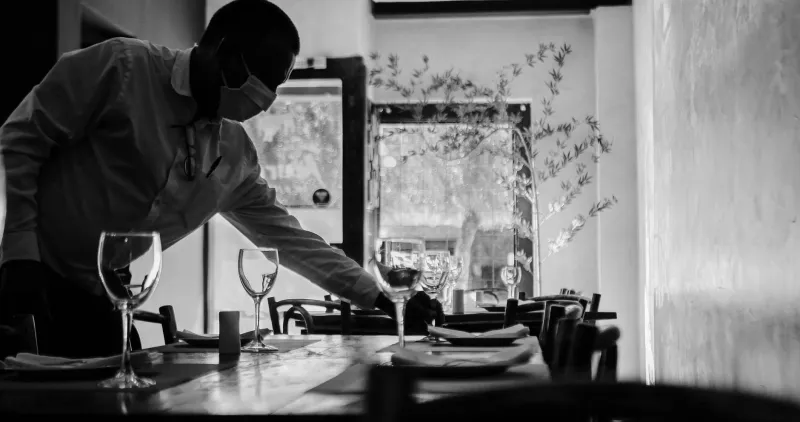
In this context, the server's role during the pre-arrival interval becomes something closer to a conductor's than a waiter's. The great front-of-house professionals are students of human behavior. They know, from experience refined over hundreds of evenings, when a table needs water refilled as a quiet acknowledgment of their presence, and when the same gesture would feel like an interruption. They know which tables are in the middle of something significant and which are simply enjoying the pleasure of being unhurried.
This reading of the room is not instinctive so much as it is cultivated. It is the product of training, yes, but also of a genuine philosophy about what a restaurant is for. When a server approaches a table during the wait not to deliver anything in particular but simply to ask whether the lighting is comfortable or whether the evening has been kind—and then retreats without lingering—they are doing something quietly profound. They are confirming that the guest is seen, and then giving them back their privacy. That exchange, lasting perhaps fifteen seconds, can reset the emotional temperature of an entire table.
Designing the Wait
The physical environment of a bistro participates in this interval as actively as the staff does. Lighting calibrated to flatter without flattening. Music pitched at a volume that allows conversation without requiring effort. The distance between tables set to provide a sense of privacy without isolation. These are not decorative choices. They are functional ones, designed to make the waiting feel like a gift rather than a gap.
At Ellison Bistro, the interval between ordering and eating is understood as part of the meal's narrative arc. The kitchen does not race to fill the silence; it respects it. Courses arrive when they are ready and when the table is ready for them—two conditions that do not always coincide and that the dining room team works to align. The result is a pacing that guests often describe, afterward, as effortless, though it is anything but.
What We Carry Away
Memory is selective in ways that favor emotion over detail. Most guests, asked to describe a meal weeks or months after it occurred, will recall not the precise preparation of a particular dish but the feeling of the evening as a whole—the sense that time moved differently inside that room, that the conversation arrived somewhere it had been trying to reach, that something was said or heard or decided that mattered.
The food contributes to this memory, certainly. But the frame around the food—the atmosphere, the pacing, the quality of the waiting—shapes how the meal is stored and how it is later retrieved. A dish served too quickly, before a guest has had time to settle into the evening, may be technically perfect and emotionally forgettable. The same dish, arriving after a well-tended interval, after a conversation that has found its depth, after the particular pleasure of genuine anticipation, becomes something else entirely.
It becomes the reason the reservation is made again.
The bistro that grasps this truth—that the space before the plate is not dead time but living time, not absence but presence—has understood something essential about hospitality. It has understood that a meal is not a transaction completed when the check is paid, but an experience assembled from many ingredients, the most invisible of which may also be the most powerful: the deliberate, generous, unhurried art of making someone wait in exactly the right way.